
Drop Privacy runs the same idempotent, checkpointed sequence from a background worker each cycle. Here's exactly what happens — and where your data does and doesn't go.
Plain English: a hash is a one-way fingerprint of an identifier — we can compare fingerprints without sharing the original name or email. A reverse index lets us look up "does this deletion request match anyone in our database?" in seconds. Forward suppression means once someone is deleted, their future leads are blocked automatically. Attestation is the printable proof you keep for auditors.
Nothing about the cycle requires a human watching a screen. It's started by a worker or cron, survives a crash, and can be safely re-run.
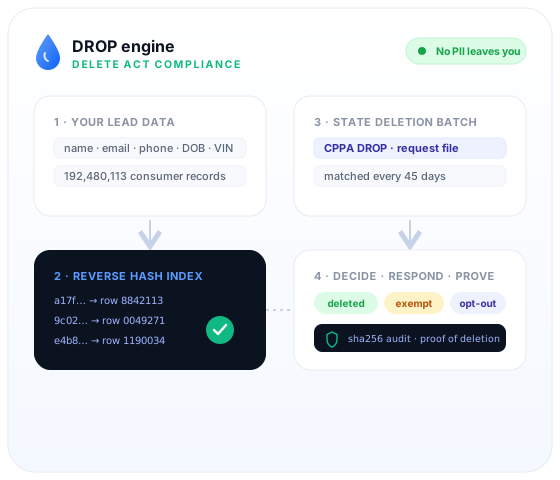
Your consumer identifiers (name, email, phone, date of birth, VIN, and more) are normalized and transliterated to a canonical form, then hashed. The result is a reverse hash index: one row per identifier hash pointing back to the source record. It's built incrementally using a high-water mark, so new leads are folded in without re-scanning everything, and stale entries are purged on a schedule.
The cycle pulls the outstanding request file from California's DROP platform and matches each consumer's hashes against your index. Because both sides are hashed and normalized identically, matches are exact and reproducible — and the comparison happens without either party exchanging raw personal information.
Each record gets a status: deleted, exempt (a lawful basis to retain), opted-out, or not found. The decision rules are configurable per tenant, so a broker's specific exemptions and identifier weighting are honored without changing the engine.
Drop Privacy answers through the DROP API (new responses and corrections each go through their correct endpoint), redacts or suppresses matched leads, and adds each consumer to a forward-suppression list so their future imports are rejected automatically. Every action is sealed into a hash-chained audit log that produces a proof-of-deletion lookup and a printable attestation.
However your leads live today — in database tables, in massive CSV exports, or behind a wall where nothing is allowed to leave — Drop Privacy meets them there. Every path ends the same way: matched against the state batch, deleted, and provably attested.
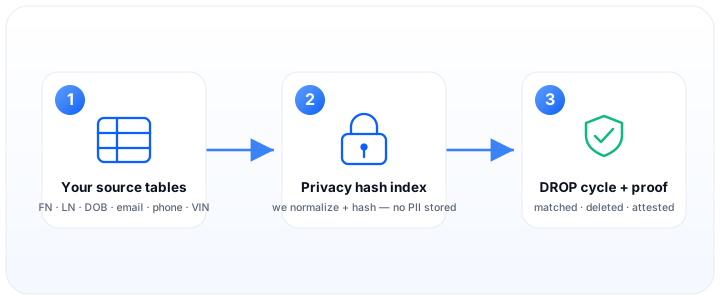
Point us at the tables where your consumers live — first name, last name, date of birth, ZIP, phone, email, VIN, MAID, CTV ID. We handle the rest.
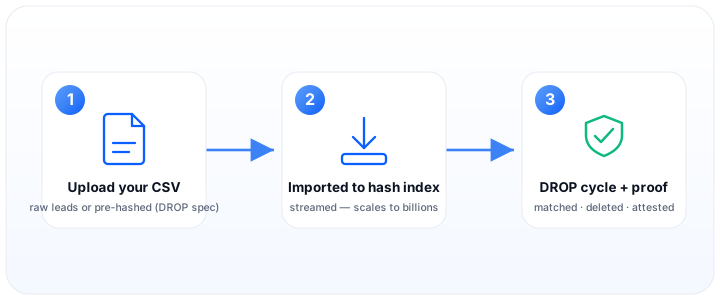
No database connection needed. Upload a delimited file of leads — or, if your team already hashes to the DROP spec, upload the pre-hashed records and skip sharing raw PII entirely.
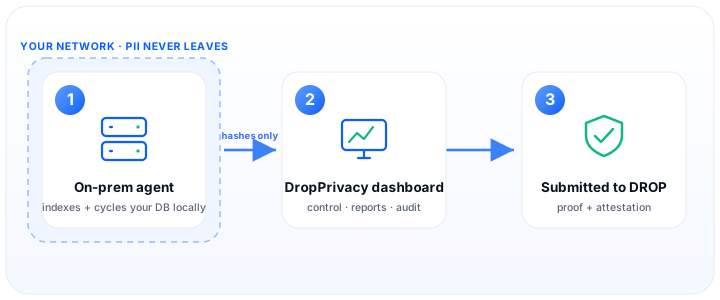
For brokers who can't share PII or hashes off-site — or whose database is simply too large to move — deploy the Drop Privacy agent inside your own perimeter. It does the heavy lifting locally; the dashboard stays in control.
Available now. Download signed Windows or Linux installers from your dashboard after onboarding. The agent indexes and cycles inside your network; only hashes, progress, and reports reach the coordination plane. See the security model or request a demo to walk through deployment.
We'll walk you through indexing, matching, deciding, responding, and the attestation it produces — on sample data, in one short session.